Slope County Dog Registration Information
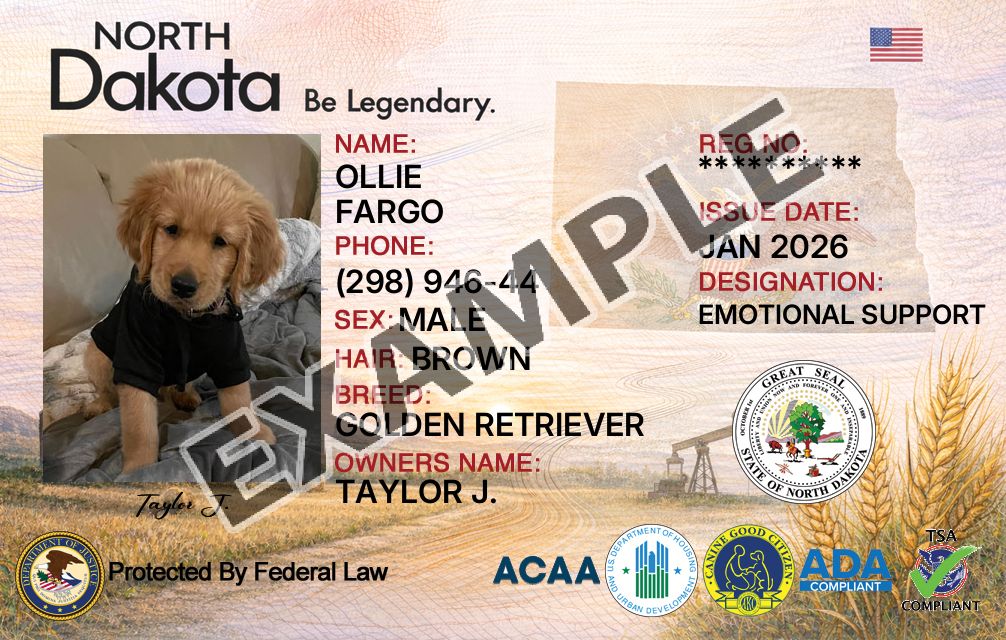
Service Dogs and Emotional Support Animals in Slope, North Dakota
If you’re asking where do I register my dog in Slope County, North Dakota for my service dog or emotional support dog, the most important thing to know is that “registration” can mean different things. In most communities, a dog license in Slope County, North Dakota is a local identification and compliance record (often tied to rabies vaccination), while a service dog is defined by training and disability-related work under federal law, and an emotional support animal (ESA) is generally recognized only in limited housing contexts.
Because dog licensing is often handled at the county seat, courthouse, sheriff, or a city office (when you live inside city limits), the best starting point for where to register a dog in Slope County, North Dakota is your local Slope County offices in Amidon and, if you live in town, your city office.
- A dog license is a local permit/record (often connected to rabies vaccination and animal control).
- A service dog is not “registered” by the government to be legitimate; its legal status comes from training to do disability-related tasks.
- An emotional support animal is not a service dog and does not get public-access rights; it may have certain housing protections when properly documented.
Where to Register or License Your Dog in Slope County, North Dakota
Below are example official offices that residents commonly contact for local records, enforcement questions, or direction on an animal control dog license Slope County, North Dakota process. Availability of dog licensing can vary by city vs. unincorporated county areas, so these offices are listed to help you confirm the correct point of contact without relying on third-party services.
Slope County Courthouse (Main Phone)
| Address | 206 Main St, Amidon, ND 58620 |
|---|---|
| Phone | (701) 879-6275 |
| Office hours | 8:30am – 5:00pm (regular courthouse hours) |
| Not publicly listed for the courthouse main line |
Use the courthouse main line if you’re unsure whether licensing is routed to the county auditor/treasurer, a clerk, or another local official in Slope County.
Slope County Auditor (County Office Contact)
| Office name | Slope County Auditor |
|---|---|
| Street address | 206 Main St |
| City / State / ZIP | Amidon, ND 58620-9012 |
| Phone | (701) 879-6276 |
| lbuzalsky@nd.gov | |
| Office hours | Not publicly listed |
If Slope County issues dog licenses at the county level (common in rural areas), the auditor’s office is a practical place to ask which form, fee, and proof is required.
Slope County Sheriff’s Office (Enforcement & Animal Control Questions)
| Office name | Slope County Sheriff’s Office |
|---|---|
| Mailing address | PO Box 485 |
| City / State / ZIP | Amidon, ND 58620-0485 |
| Phone | (701) 879-6271 |
| rmteigen@nd.gov | |
| Office hours | Not publicly listed |
The sheriff’s office is often the best contact for local enforcement questions (running-at-large, bite reports, rabies exposure procedures, and where “animal control” functions are handled in a small county).
Overview of Dog Licensing in Slope County, North Dakota
What “licensing” typically means in rural North Dakota counties
A local dog license is usually a county or city record that helps identify the dog’s owner and shows that the dog meets baseline public health rules (most commonly, a current rabies vaccination). In many communities, licensing is tied to nuisance and safety enforcement—things like dogs running at large, bite incidents, or repeated complaints.
Who enforces rabies-related rules and animal incidents
In smaller counties, day-to-day “animal control” functions may be handled by local law enforcement rather than a separate animal services department. For questions that sound like enforcement (loose dog, bite report, quarantine guidance after a bite, or proof requests), contact the Slope County Sheriff’s Office. For questions that sound like local records, fees, or tags (if issued), start with the courthouse or county auditor.
Rabies vaccination expectations
Rabies is a serious public health concern. While the exact local licensing steps can vary, it is common for local licensing and compliance checks to rely on proof that a dog’s rabies vaccination is current. If your dog bites someone or is exposed to a suspected rabid animal, public health and local officials may provide specific instructions. Keeping vaccination records organized is one of the simplest ways to avoid delays if you are asked for proof.
How Dog Licensing Works Locally in Slope County, North Dakota
Step-by-step: how to find the right licensing office
- Start with the Slope County Courthouse main line and ask: “Which office handles dog licensing or dog tags for Slope County residents, and does it differ by city limits vs. rural addresses?”
- Confirm whether your residence is inside a city’s jurisdiction (if so, the city may have its own licensing ordinance and process).
- Ask what documentation is required (commonly rabies vaccination proof, an ID, and proof of residency).
- Ask about renewals, deadlines, and fees (including whether working service dogs have any fee waivers locally—policies vary).
What you may be asked to provide
When a local office issues licenses or maintains records, they usually need enough information to identify the animal and the owner. Even if Slope County does not issue a formal tag for all county residents, you may still be asked for proof of rabies vaccination in certain situations (for example, after a bite incident, during an investigation, or when required by a city ordinance).
Why “animal control dog license Slope County, North Dakota” can mean different things
In metropolitan areas, “animal control” is often a standalone department that sells licenses and enforces pet ordinances. In rural areas, those responsibilities may be split: a county office may handle records or fees, while the sheriff handles enforcement and complaint response. That’s why the quickest route is often to call the courthouse, then contact the sheriff for enforcement-related questions.
Service Dog Laws in Slope County, North Dakota
A service dog is not “made legal” by a registration
A legitimate service dog is defined by what it is trained to do for a person with a disability—specifically, it is trained to perform tasks or work directly related to that disability. There is no universal government registry that you must join to “register” a service dog.
Dog license vs. service dog status (two separate concepts)
Dog license (local)
- Local permit/record for ownership and compliance
- Often linked to rabies vaccination proof
- May involve a fee and renewals
- Helps with identification and enforcement
Service dog (legal status)
- Based on training and disability-related tasks
- No official “certificate” required to be valid
- Access rights come from law, not a local tag
- Still must follow public safety rules (control, behavior)
Do service dogs still need local licensing?
Possibly. A service dog can still be subject to the same local animal rules that apply to other dogs (leash/control rules, vaccination requirements, and—where applicable—local licensing). If you want to know whether a dog license in Slope County, North Dakota is required for all dogs, including service dogs, call the courthouse or auditor and ask how local rules are applied in your jurisdiction.
Emotional Support Animal Rules in Slope County, North Dakota
ESAs are not service dogs
An emotional support animal provides comfort by its presence, but it is not trained to perform disability-related tasks in the way a service dog is. As a result, ESAs generally do not have public-access rights to enter places where pets are not allowed.
How ESA status interacts with local licensing
ESA status typically does not replace local responsibilities like vaccination requirements, animal control rules, or local licensing where it exists. In practical terms: even if your dog is an ESA, you should still be prepared to provide rabies vaccination proof and follow local ordinances.
Avoiding common “registration” confusion
Many people search for “ESA registration,” but third-party registries are not required for the limited protections ESAs may have. If your real goal is compliance and peace of mind, focus on the local requirements first: keep rabies paperwork current, ask your local office whether a license or tag is required, and keep your identification and residency proof ready.
Frequently Asked Questions
Register A Dog In Other North Dakota Counties
Select your county below to get started with your dog’s ID card. Requirements and license designs may vary by county, so choose your location to see the correct options and complete your pup’s registration.
- Adams County Dog Registration
- Barnes County Dog Registration
- Benson County Dog Registration
- Billings County Dog Registration
- Bottineau County Dog Registration
- Bowman County Dog Registration
- Burke County Dog Registration
- Burleigh County Dog Registration
- Cass County Dog Registration
- Cavalier County Dog Registration
- Dickey County Dog Registration
- Divide County Dog Registration
- Dunn County Dog Registration
- Eddy County Dog Registration
- Emmons County Dog Registration
- Foster County Dog Registration
- Golden Valley County Dog Registration
- Grand Forks County Dog Registration
- Grant County Dog Registration
- Griggs County Dog Registration
- Hettinger County Dog Registration
- Kidder County Dog Registration
- LaMoure County Dog Registration
- Logan County Dog Registration
- McHenry County Dog Registration
- McIntosh County Dog Registration
- McKenzie County Dog Registration
- McLean County Dog Registration
- Mercer County Dog Registration
- Morton County Dog Registration
- Mountrail County Dog Registration
- Nelson County Dog Registration
- Oliver County Dog Registration
- Pembina County Dog Registration
- Pierce County Dog Registration
- Ramsey County Dog Registration
- Ransom County Dog Registration
- Renville County Dog Registration
- Richland County Dog Registration
- Rolette County Dog Registration
- Sargent County Dog Registration
- Sheridan County Dog Registration
- Sioux County Dog Registration
- Stark County Dog Registration
- Steele County Dog Registration
- Stutsman County Dog Registration
- Towner County Dog Registration
- Traill County Dog Registration
- Walsh County Dog Registration
- Ward County Dog Registration
- Wells County Dog Registration
- Williams County Dog Registration